Winners of the 2026 Underwater Photographer of the Year Contest
· The Atlantic
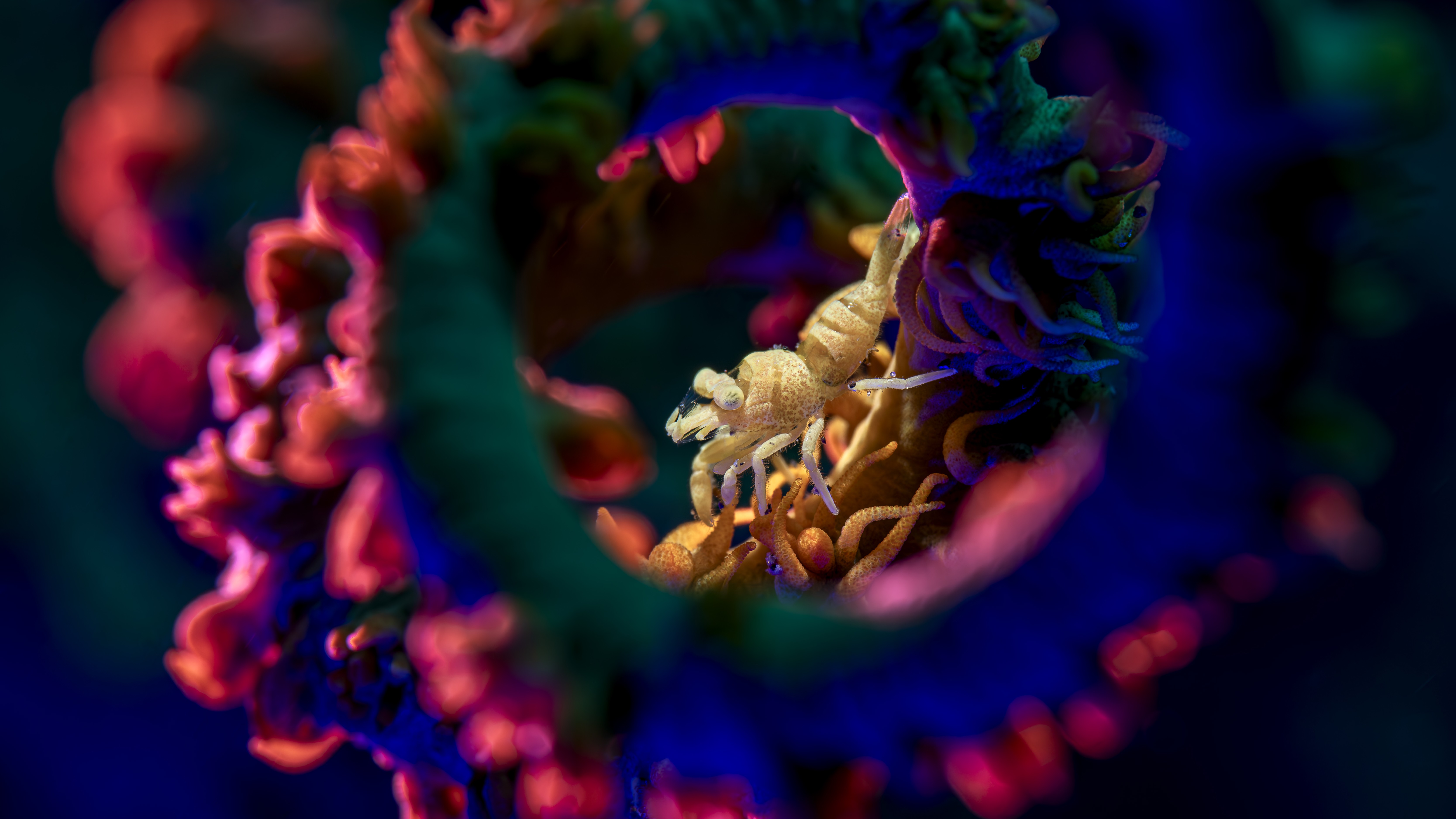
© Seong-Cheol Cho / UPY2026Calm at the Heart of Turmoil. Winner, Macro. Cho: “While diving in Tulamben with my guide, Jaye, I encountered a commensal shrimp living within a naturally spiraling whip coral. Something I had long hoped to see, the coral’s deep, rich green formed a striking nest for the brightly colored shrimp resting inside. By introducing red and blue light against the green coral, I wanted to create a sense of intense beauty combined with visual turbulence, while expressing the shrimp’s stillness at the center."© Sam Blount / UPY2026Lunging Leopard. Winner, Up & Coming, and Up & Coming Underwater Photographer of the Year. Blount: “For years, the leopard seal topped my Antarctic wish list, a predator I dreamed of encountering face to face. I have to say, this dive was everything I could have hoped for: clear water, good lighting, and a playful seal. Leopard seals wield an astonishing array of dominance displays, and this one put them all to use, darting around me with effortless power.”© David Alpert / UPY2026Power and Pace. Third Place, Black & White. Alpert: “December in Cape Town and the young fur seals are super active, playing in the waves as they crash onto the jagged rocks of Duiker Island. Joining them in the surf is exhilarating, though photography is incredibly difficult. These animals shoot through the swell like lightning bolts; there is no time for autofocus, only instinct.”© Matty Smith / UPY2026Rockpool Rookies. Winner, Portrait, and Underwater Photographer of the Year 2026. Smith: “Once several weeks old and weaned from their mother’s milk, elephant seal pups are abandoned by their parents on shore, left to navigate life alone. On Sea Lion Island in the Falklands, I watched dozens of them clamber over one another in shallow rockpools, awkwardly learning to swim, and quite engaging to my presence. I’d come here for this moment, to witness and photograph their first solo lessons in life.”© Ilaria Mariaguilia Rizzuto / UPY2026Rescued and rehabilitated at CESTHA. Third Place, “Save our Seas Foundation” Marine Conservation. Rizzuto: “This image is part of a photographic reportage produced at the CESTHA marine rescue center in Italy, documenting the daily work behind marine-wildlife rehabilitation. The turtle is a large adult female, estimated to be around 45 years old, being moved from the therapy tank into a tub for transport to the sea after months of care.”© Fabian Becker / UPY2026JAWS. Second Place, Macro. Becker: “In Bohol, Philippines, lizard fish are common and easily overlooked reef inhabitants, typically encountered resting motionless on sand or rubble. With this image, I wanted to move beyond the predictable image of a sedentary ambush predator and reveal an unexpected view of the species.”© Ventura Romero / UPY2026Together we can! Second Place, Behavior. Romero: “A rare and unexpected behavioral observation. A group of sperm whales were engaged in social behavior at a depth of approximately 20 meters. While descending and attempting to align the camera-housing viewfinder with my mask to frame the scene, a sudden movement in my right peripheral vision drew my attention. Within seconds, an oceanic whitetip shark appeared in front of me, briefly approached and visually assessed me, then abruptly turned and retreated.”© Simon Theuma / UPY2026A Time to Dream. Third Place, Macro. Theuma: “I have a rather special spot near Shellharbour, New South Wales, my local dive site, just a short 15-minute drive from home. It’s a dive site bursting with life, and every dive there feels like an adventure. I always see mosaic sea stars, and their bright colors always catch my eye. This time, I was lucky enough to find a tiny commensal shrimp, just about 20 millimeters long, nestled on one of the sea star’s arms.”© Steven Kovacs / UPY2026Screaming Swallower. Second Place, Portrait. Kovacs: “Every year off the coast of Florida, from late July to early October, Kali colubrina, a fish belonging to the family Chiasmodontidae and commonly known as snaketooth fishes or swallowers, makes an appearance during blackwater dives. Fish in this family are renowned for their ability to consume prey larger than themselves, with mouths and stomachs capable of expanding to accommodate prey up to twice their length and 10 times their weight.”© Jean-Baptiste Cazajous / UPY2026Living Wreck. Second Place, Wrecks. Cazajous: “The Donator, or Prosper Schiaffino, is a cargo shipwreck that was sunk by a mine in 1945. It is one of the most famous wrecks on the French coasts of the Mediterranean Sea. This wreck is an amazing artificial reef. Every inch of it is covered in life.”© Cecile Gabillon Barats / UPY2026Happy Baby. Winner, Wide Angle. Barats: “As a tour leader and photographer in Dominica, I was fortunate to experience a truly magical encounter with a curious juvenile sperm whale. We entered the water at a respectful distance alongside the mother and her calf, watching as the mother prepared to dive in search of food, leaving her youngster at the surface. Almost immediately, the calf spun around and approached us, coming remarkably close, mouth wide open to reveal his emerging teeth, rolling playfully upside down. It seemed he was eager to interact. We could clearly see a chunk of squid held in his jaw and the many scars already etched into his skin.”© Shunsuke Nakano / UPY2026Coral Window. Winner, Black & White. Nakano: “Light enters the wreck through a window, a square cut into history and now taken over by life. Choosing to shoot in black and white, I am inviting the viewer to contrast the thick, straight manmade lines with the delicate and intricate patterns of nature. Gorgonians fan outward like frozen breath, turning rust into art. Between them, a lone wrasse punctuates the frame, providing movement in an otherwise still composition.”© Dan Bolt / UPY2026New Life. Third Place, British Waters Macro. Bolt: “I had to be careful, while getting this shot, not to disturb the attendant adult scorpionfish who was protecting their newly laid eggs. I wanted to capture the tiny, still-forming eyes within each little round embryo, while at the same time having enough depth of field to show just how densely packed they were in the nest.”© Kirsty Andrews / UPY2026Dusk Encounter. Second Place, British Waters Wide Angle. Andrews: “Twenty twenty-five has truly been the Year of the Octopus in southern England, as these eight-armed wonders have taken over coastal reefs in significant numbers. Porthkerris in Cornwall has been a particular hot spot for divers to see them. As dusk fell and darkness started to descend, I followed a large, confident individual, patrolling and making fascinating poses as it moved. Turning a corner, it chanced upon another large octopus, and suddenly the two sprang together into this mysterious scene.”© Evan Johnston / UPY2026A Meeting of Giants. Winner, British Waters Wide Angle. Johnston: “What started out with two large sharks feeding at the surface turned into three, then four, then five over the course of the day. At some point most of the sharks had gone, and after watching the last tail fade away, I turned around and was greeted with the image here. These sharks had stopped feeding and formed a tight shoal, before breaking off and swimming in slow rhythmic circles, eventually spiraling off into the deep. This behavior is known as a torus and is thought to be a courtship behavior and the precursor to mating—although that remains a mystery.”© Kazushige Horiguchi / UPY2026Clownfish Hatchout. Winner, Behavior. Horiguchi: “This photograph captures the exact moment clownfish eggs hatch in Kagoshima Prefecture, Japan. In the late afternoon, my close friend Koji Matsuda told me that the eggs would hatch that day. Even before hatching, the parent clownfish carefully guarded the eggs, constantly watching for predators as they waited for the moment to come. I was able to capture the instant the larvae emerged.”
Be sure to visit the official site of the competition to see all the winners.
Visit rhodia.club for more information.